Bullion License: 40734704

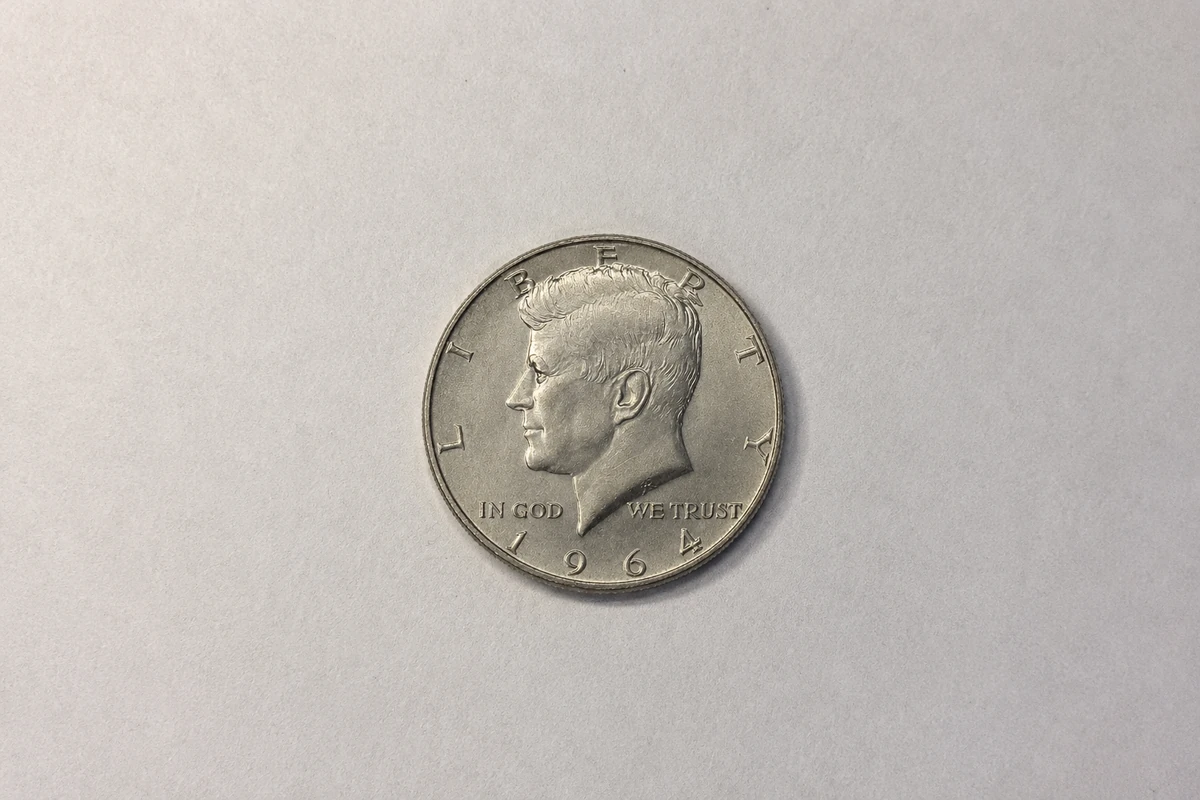
Every half dollar dated 1970 or earlier contains silver, which makes it worth many times its face value. Coins from 1892 through 1964 are 90% silver, and the 1965 to 1970 Kennedys are 40%. Later half dollars are copper-nickel and worth fifty cents, apart from a few varieties and collector issues covered below. A handful of dates run into the hundreds or thousands, and a few have sold for six figures.
Checking your own coin takes about a minute. Start with the date.
Silver content is the single biggest factor in what a half dollar is worth, and the date tells you almost everything.
The values below are based on a silver price sitting around $67 per troy ounce as of September 5, 2026.
| Years | Series | Silver | Silver weight | Silver value |
| 1892 to 1964 | Barber, Walking Liberty, Franklin, 1964 Kennedy | 90% | 0.36169 troy oz | about $24 |
| 1965 to 1970 | Kennedy | 40% | 0.1479 troy oz | about $10 |
| 1971 to present | Kennedy (struck for circulation) | none | none | 50 cents |
| 1776 to 1976 with an S mintmark, from collector sets | Bicentennial Kennedy | 40% | 0.1479 troy oz | about $10 |
| 1992 to 2018 silver proof sets | Kennedy | 90% | 0.36169 troy oz | about $24 |
Two things to take from that table. Silver value is a floor rather than a ceiling, and it moves with the market every day, so the dollar figures shift while the silver weights never do. If silver has moved since this page was updated, multiply the weight in the fourth column by the current silver price to get your own number. A 90% half dollar always holds 0.36169 troy ounces, whatever the market is doing.
The important line is 1970. Anything dated 1970 or earlier holds silver. Anything after that is worth fifty cents unless it is a known variety or a high-grade uncirculated coin.
The Kennedy is the half dollar most people find in a drawer, and its value depends almost entirely on the year.
The 1964 issue is 90% silver, so even a worn one carries the full silver value shown above. From 1965 through 1970 the Mint dropped to 40% silver. From 1971 onward, circulating halves contain no silver at all.
No regular-issue Kennedy is genuinely rare, but several are worth noting:
Every Franklin half dollar is 90% silver. Condition is what separates a melt coin from a collector coin.
Franklins are graded partly on the Liberty Bell's Full Bell Lines, meaning the horizontal lines across the bottom of the bell are complete and unbroken. That detail carries the value. PCGS estimates only about 200 examples of the 1953-S exist with Full Bell Lines in any grade, and an uncirculated one runs around $30,000. The auction record for the date is $69,000, set at a Bowers & Merena sale in 2001. The same coin without those lines is worth a small fraction of that.
The dates to check:
Franklin half dollars are worth at least the value of their silver, and a few are worth thousands. The bell tells you which is which.
The Walking Liberty half dollar is 90% silver, and widely considered one of the best-looking American coins ever struck. Common dates from the 1940s trade close to melt value. The early years are where the money is.
The dates to check:
On a 1917 Walking Liberty half dollar it's worth checking which side the mintmark is on. Early that year the D or S sat on the front below IN GOD WE TRUST, then the Mint moved it to the reverse near the bottom left. San Francisco made 952,000 with the mintmark on the front and 5,554,000 with it on the back, so the front ones are much scarcer. On worn coins the difference is small, but an uncirculated 1917-S with the mintmark on the front sold for $40,800.
The 1921s are the main ones to look for, along with a few other select years and 1917s carrying the mintmark on the front.
All Barber half dollars are 90% silver. Worn ones are easy to come by and trade close to melt, but coins that kept their detail are genuinely scarce. PCGS calls Fine examples scarce, Very Fine very scarce, and Extremely Fine rare.
The dates to check:
Seated Liberty halves came before these and run across several design types with very different values, so anything older than 1892 is worth having looked at by a professional.
This answer disappoints most people, but nearly every Bicentennial half dollar is copper-nickel clad and worth exactly fifty cents. Hundreds of millions were struck at Philadelphia and Denver, and plenty are still in circulation.
The exception is the silver version. The Mint sold 40% silver Bicentennial halves in special three-coin collector sets, and those hold the same 0.1479 troy ounces as a 1965 to 1970 Kennedy.
One thing to note: Do not clean, polish, or dip your half dollars. Cleaning strips the original surface and can cut a coin's value in half or worse, and any dealer or grading service will spot it immediately.
Two mistakes cost people the most money. The first is spending silver halves at face value or taking them to a bank, which pays fifty cents for a coin holding many times that in silver. The second is selling an unsorted collection by weight, which prices a scarce date exactly the same as a worn common one.
A dealer who handles both bullion and collector coins will sort by date and grade before making an offer. Sometimes everything really does just sit at melt value. Other times there may be a 1921-D in the bag!
Bring your half dollars to St. Louis Park Gold & Silver at 4825 Minnetonka Blvd, right off Highway 100, or call 952-217-5488 first. We check every coin, quote against the live silver market, and pay cash or check. There is no charge and no obligation to sell. You can also read more about how we buy and sell rare coins or buy and sell silver.
Which years of half dollars are worth money? Anything dated 1964 or earlier, because those coins are 90% silver and worth many times face value in metal alone. Halves from 1965 through 1970 are 40% silver and worth roughly 40% as much. The table on this page gives the current figures at today's silver price. Beyond silver content, the dates that bring the most money are the 1921-D and 1921 Walking Liberty, the 1949-S and 1953-S Franklin, the early Barber issues, and a handful of Kennedy varieties.
Are 1776 to 1976 half dollars worth anything? Almost all of them are worth fifty cents. The Mint struck hundreds of millions for circulation in copper-nickel. The only Bicentennial halves with real value are the 40% silver versions sold in collector sets, which carry an S mintmark and hold the same silver as a 1965 to 1970 Kennedy.
What makes a 1971 half dollar rare? Nothing, in most cases. 1971 was the first year the Mint struck half dollars with no silver at all, and more than 450 million were made across Philadelphia and Denver. A 1971 half is worth fifty cents unless it is a flawless uncirculated example or carries a known die variety.
How do I tell if my half dollar is worth anything? Check the date first, then look at the edge for a copper stripe. If the coin is dated 1970 or earlier, it holds silver and is worth well over face value. If it is newer, check the mintmark and the condition. Do not clean it either way.
Are half dollars still made? Yes. The Mint stopped striking half dollars for general circulation after 2001 and produced them for collectors only through 2020, then resumed circulation strikes in 2021. They remain legal tender, but banks rarely stock them, which is why they seem to have disappeared.
COVID 19 Protocols
Ask about "Mystery Boxes"
Phenomenal Service
